
Overheating, Coolant Leaks, Failed Water Pumps —
Same-Day Cooling System Repair for Semi-Trucks and Fleets in Dallas, TX
A cooling system failure is the cheapest repair to make right today and one of the most expensive to ignore until tomorrow. Once the engine overheats, head gaskets warp, cylinder heads crack and a $200 hose turns into a $15,000 engine job.
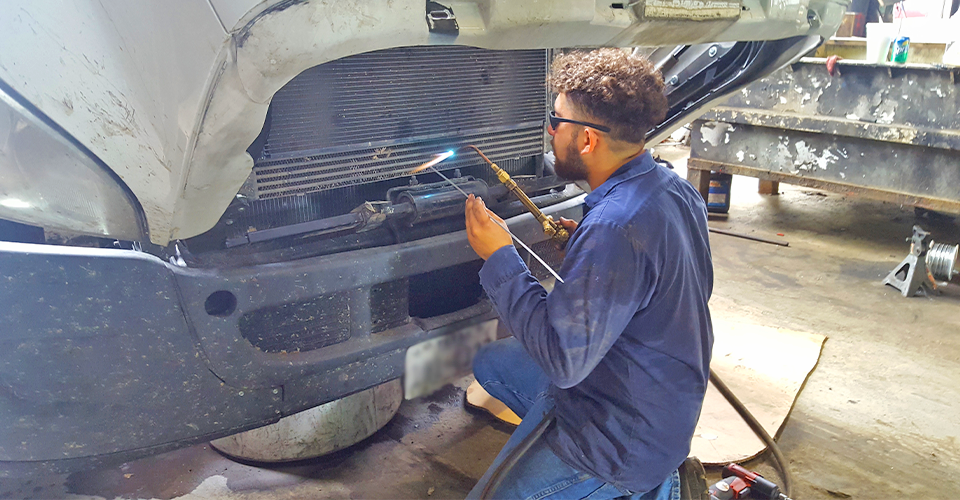
At Salazar Semi-Truck Repair Inc. we pressure-test the cooling system, isolate the exact failed component, repair it and verify the system holds operating temperature before the truck leaves. Emergency same-day service for owner-operators and fleets across Dallas–Fort Worth.
Salazar Semi-Truck Repair Inc. — 2323 Chalk Hill Rd, Dallas, TX 75212
Why Drivers and Fleets Trust Salazar With Cooling System Repair
- Heavy-duty cooling specialists: Daily diagnostics on Cummins ISX/X15, Detroit DD13/DD15/DD16, Volvo D13, Mack MP8 and Cat C15 cooling systems.
- Heavy-duty only: No cars, no light trucks — just semi-trucks, box trucks, dump trucks, roll-offs and commercial fleets.
- Pressure testing first, repair second: Manual hand-pump pressure tests expose leaks under operating conditions. UV dye injection traces hidden leaks. No guess-and-replace work.
- Component-level diagnosis: Hoses, clamps, water pump, radiator core and tanks, thermostat housing, heater core, freeze plugs, EGR cooler, fan clutch — each tested individually.
- Correct coolant chemistry on refill: ELC, OAT, HOAT or IAT per engine spec, with SCA additive verification when applicable.
- Written estimate before any major work begins.
- Fleet-friendly documentation: Unit numbers, mileage, leak source, parts replaced and PM recommendations on every repair.
- Strategic location: 2323 Chalk Hill Rd, near major DFW freight corridors and intermodal terminals (BNSF Hutchins, Union Pacific Wilmer).
What Heavy Truck Cooling System Repair Actually Covers
Cooling system repair on a Class 8 truck is more than swapping a hose. The system has 10+ critical components, each with its own failure pattern, diagnostic procedure and replacement specification. A proper repair confirms which component failed, replaces it correctly, and decontaminates everything the failure touched.
Components We Service
- Radiator core, tanks and side seams: Plastic tank cracks, aluminum core stress fatigue, rock-strike damage and integrated transmission cooler failures.
- Water pump: Mechanical pumps with weep-hole leaks, gear-driven pumps with shaft seal failures, and gasket leaks at the mounting surface.
- Thermostat and thermostat housing: Stuck-open thermostats causing slow warm-up, stuck-closed thermostats causing overheating, and housing gasket weeps.
- Upper and lower radiator hoses, heater hoses, bypass hoses: The single most common leak source — split, cracked, ballooned or pinhole-leaking hoses, plus failed hose clamps and quick-connect couplers.
- Heater core: Interior cab leaks, fogging windshield, sweet smell from vents, and heater performance loss.
- Freeze plugs (core plugs): Steel cup plugs corroding through after years of service.
- EGR cooler (external leaks): Coolant weeping from EGR cooler housing or inlet/outlet ports, separate from internal EGR cooler failures that put coolant into the exhaust or oil.
- Fan clutch and viscous fan hub: Failure to engage at high temperatures, locked-up fans, leaking silicone fluid or worn bearings.
- Surge tank, expansion tank and overflow tank: Plastic cracks, cap pressure-relief failures and seal degradation.
- Charge air cooler / intercooler: Less commonly the source but can leak coolant or be confused with coolant failures during diagnosis.
- Coolant itself: Testing chemistry, pH, freeze point, SCA levels on heavy-duty platforms, and full system flush after contamination.
- Hose clamps, fittings and quick-connects: Corroded, fatigued or improperly torqued connections that leak under cooling system pressure.
Engine-Specific Cooling System Patterns We See Every Week
Every engine family has its own cooling system failure signatures. Knowing the engine narrows the diagnosis from the first phone call.
- Cummins ISX, X15, ISL, ISC: EGR cooler external leaks, water pump weep holes, lower hose connection failures, and head gasket failures after overheating events.
- Detroit DD13, DD15, DD16: Radiator hose failures from heat cycling, water pump shaft seals, and EGR cooler internal failures (which then become coolant-in-oil cases).
- Volvo D11, D13, D16: Heater hose failures inside the cab area, fan clutch failures, and overheating-driven head gasket events.
- Mack MP7, MP8, MP10: Similar pattern to Volvo on the cooling side, with additional EGR cooler failures.
- Cat C13, C15, C16, 3406: Water pump failures, radiator core damage and freeze plug corrosion on older platforms.
- International MaxxForce 13: Notorious EGR cooler failures and head gasket events driven by cooling system stress.
Common Symptoms That Bring Trucks to Our Cooling System Bay
Most cooling system jobs start with one of a small number of symptoms. If you are experiencing any of these, our diagnostic-specific pages walk through the exact causes and repair scope for each:
- Visible coolant puddle under the truck — see our Semi-Truck Coolant Leak diagnosis page for component-by-component sources.
- Engine overheating while driving — see Overheating While Driving for the causes specific to operating temperature climb.
- Milky oil on the dipstick — see Coolant in Engine Oil for head gasket, oil cooler and EGR cooler diagnosis.
- Diesel film in the coolant — see Diesel in Coolant for injector cup and head crack diagnosis.
- Oily film in the coolant overflow tank — see Oil in Coolant Overflow for transmission cooler and hydraulic intrusion diagnosis.
- Engine overheating but the coolant tank looks full — see our article Truck Overheating But Coolant Full for less obvious causes.
- General engine overheating causes — see What Causes Engine Overheating for a full breakdown.
- Water pump replacement specifically — see Semi-Truck Water Pump Replacement.
Our Cooling System Diagnostic Process Step-by-Step
Finding the exact source is faster and cheaper than swapping parts on guesswork. Our process:
- Visual inspection cold: Tracing dried residue, white crust and wet spots along every hose, fitting, pump, radiator surface, thermostat housing, freeze plug location and EGR cooler.
- Cooling system pressure test: Hand-pumping the system to operating pressure with the engine off and watching for pressure drop.
- UV dye injection when needed for hard-to-find leaks — circulate, run the engine, then trace under blacklight.
- Heater core isolation test if a cab leak is suspected — pressurized independently of the rest of the system.
- Water pump weep-hole inspection.
- Radiator core, tank and side-seam inspection plus separate radiator pressure test if suspect.
- Thermostat function test for stuck-open or stuck-closed conditions.
- Fan clutch engagement test at operating temperature.
- EGR cooler external pressure test to confirm internal versus external leak path.
- Combustion gas test on coolant when warranted to rule out a head gasket breach.
- ECM scan and temperature history to confirm whether the engine has been overheating without the driver noticing.
- Coolant chemistry test (pH, freeze point, SCA levels) before refill.
- Post-repair pressure test and supervised run-up to confirm the system holds operating temperature without loss.
Cooling System Services We Offer
Emergency Same-Day Cooling System Repair
For trucks already overheating, leaking visibly or showing low-coolant warnings, we provide same-day pressure testing, source isolation and repair. Most cooling system emergencies — hoses, water pumps, thermostats, freeze plugs — are repairable in a single day. Larger jobs (radiator replacement, EGR cooler service, head gasket diagnosis) are scoped immediately and quoted before any work begins.
Scheduled Cooling System Service & PM
For trucks not yet in failure but approaching service intervals, we offer scheduled cooling system inspections that include hose and clamp condition assessment, water pump weep-hole check, fan clutch verification, coolant chemistry test, pressure test and predictive replacement of components approaching service life. Catching a 12-year-old hose set before it fails is always cheaper than replacing it after the truck overheats.
Component Replacement
When a specific component is confirmed failed, we replace it with the correct OEM-equivalent or OE part, refill with the correct coolant chemistry, pressure-test the repair and verify operating temperature is held. Component replacements include radiators, water pumps, thermostats, hoses, heater cores, freeze plugs, EGR coolers, fan clutches and surge tanks.
Cooling System Flush & Decontamination
After contamination events (oil intrusion, fuel intrusion, transmission fluid intrusion), the cooling system has to be fully flushed and refilled with the correct chemistry. We also offer scheduled flushes per OEM intervals to extend the life of every component the coolant touches.
Fleet Cooling System Maintenance Programs
For fleets, scheduled cooling system maintenance prevents the breakdowns that destroy delivery schedules. Our fleet programs include scheduled inspections, coolant analysis, pressure testing, hose and clamp PM, fan clutch verification, water pump inspection and predictive component replacement. Fleet customers receive priority bay access, documented PM history per unit, and consistent cost predictability across the fleet.
For Drivers
Tell us what you see — color of the puddle, where it is forming, whether the temp gauge has climbed, whether the cab smells sweet. You do not need to know whether it is the water pump or a hose — that is our job. Your job is to bring us the symptoms and to stop driving before the engine overheats.
For Owner-Operators
Cooling system repairs caught early are bounded — hoses, clamps, water pumps, thermostats, radiators. Cooling system repairs ignored until the engine overheats are unbounded — head gaskets, cracked cylinder heads, possible bottom-end damage. We work to find the source on the first visit and fix what is failing now plus what is about to fail next.
For Fleet Managers and Dispatchers
Every cooling system repair includes unit number, mileage, leak source, parts replaced, photos and PM recommendations. If we see patterns across multiple units in your fleet — repeated water pump failures around similar mileage, consistent radiator hose failures on units running specific routes, or coolant chemistry mismatches across the fleet — we tell you. That data feeds your PM cadence and prevents the next breakdown before dispatch even hears about it.
A $200 Hose Caught Today Is a Same-Day Repair — A Warped Cylinder Head From an Overheating Tomorrow Is a $15,000+ Engine Job
The math on cooling system failures is simple. Caught when the puddle first appears or the gauge first creeps, almost every cooling system problem is a hose, a clamp, a water pump, a thermostat or a radiator — serious but bounded. Ignored until the system runs dry on a long pull and the engine overheats, the cost scale flips: head gasket failure, warped or cracked cylinder head, possible bottom-end damage, and a multi-day repair instead of a same-day one. The leak source does not get more expensive over time. The damage from running it does.
Pressure-testing the system today is always cheaper than rebuilding the head tomorrow.
Cooling System Repair – Frequently Asked Questions
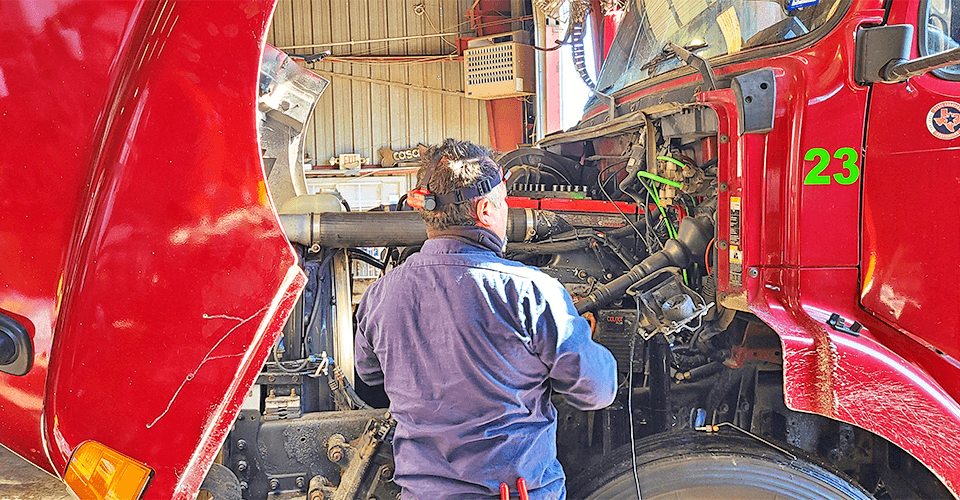
Cooling system repair on a heavy-duty truck covers every component that moves or contains coolant — radiator, water pump, thermostat, upper and lower radiator hoses, heater hoses, heater core, freeze plugs, fan clutch, EGR cooler, oil cooler, surge tank, hose clamps, fittings and the coolant itself. Repair starts with pressure testing to isolate the failed component, then component-level replacement and a full system flush before refilling with the correct coolant chemistry.
The most common signs are engine temperature climbing under load, a coolant puddle under the truck, an overflow tank that drops below the cold-fill line every shift, white sweet-smelling steam from the engine bay, low coolant warnings, sweet glycol smell from the cab vents, fogging on the windshield that returns minutes after defrost, and milky oil on the dipstick. Each symptom points to a different component and a different repair scope.
Yes. Salazar Semi-Truck Repair provides same-day emergency cooling system diagnosis and repair at our Dallas shop located at 2323 Chalk Hill Rd. We pressure-test the system, isolate the failed component, repair it, flush the system and verify it holds operating temperature before the truck leaves. Call 214-761-9082 to confirm slot availability.
Cost varies by failed component. Hose, clamp and fitting repairs are the lowest-cost outcome. Water pump and thermostat replacement are mid-range. Radiator replacement is higher. Heater core replacement is among the most expensive because it requires significant cab disassembly. EGR cooler and head gasket service add complexity. We provide a written estimate after pressure-testing so the scope is confirmed before any major work begins.
Yes. Our fleet cooling system maintenance programs cover scheduled inspections, coolant analysis, pressure testing, hose and clamp preventive replacement, fan clutch verification, water pump weep-hole inspection and predictive replacement of components approaching service life. Fleet customers receive priority scheduling, documented PM history and consistent cost predictability.
Only short distances and only if the temperature gauge stays in normal range. Once the engine starts to overheat, head gaskets warp, cylinder heads can crack, and a low-cost cooling system repair turns into a five-figure engine repair. The safe call is to diagnose the cooling problem before the next long pull. If the temperature gauge is climbing, shut the engine down and call for a tow.
We serve the entire Dallas-Fort Worth Metroplex from our shop in Dallas. Trucks come in regularly from Fort Worth, Arlington, Irving, Garland, Mesquite, Grand Prairie, Lewisville, Carrollton, Plano, Richardson, DeSoto, Lancaster, Hutchins and Wilmer. Owner-operators based at the BNSF and Union Pacific intermodal terminals are a regular part of our customer base.
Same-Day Cooling System Repair in Dallas, TX
Don't keep driving on a leaking cooling system. Don't wait for the temperature gauge to confirm what the puddle already told you. Don't add stop-leak.
Call now or bring the truck to our shop — we will pressure-test the system, find the exact source and repair it the same day.
📞 214-761-9082
📍 Get Directions 📞 Call NowFind Your Specific Symptom — Cooling System & Fluid Diagnosis Pages
If your truck is showing a specific symptom, our diagnostic-specific pages walk through the exact causes and repair scope:
- Semi-Truck Coolant Leak – External Visible Leaks
- Semi-Truck Overheating While Driving
- Coolant in Engine Oil (Milky Dipstick)
- Diesel in Coolant (Fuel-Side Breach)
- Oil in Coolant Overflow Tank
- Emergency Cooling System Repair Workflow
- Article: Truck Overheating But Coolant Full
- Article: What Causes Engine Overheating
- Article: Semi-Truck Water Pump Replacement
Related Heavy Truck Repair Services
- Semi-Truck Radiator Repair — radiator-specific service.
- Diesel Engine Repair — when overheating exposes deeper engine issues.
- Heavy-Truck Diagnostic — pressure testing, ECM scan and combustion gas test on coolant.
- Same-Day Semi-Truck Repair — emergency repair workflow for stranded units.
- Forced Regen Service — when overheating is connected to aftertreatment failure.